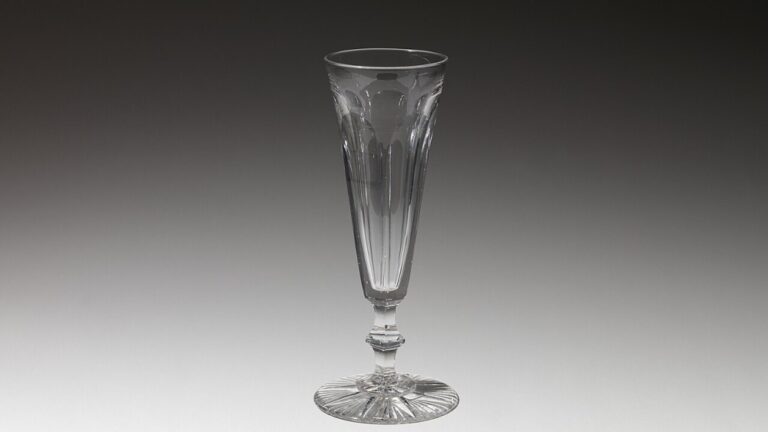
The Coupette is a stemmed cocktail glass with a V-shaped bowl, primarily used for classic short drinks served without ice. Visually, it sits between a cocktail coupe and a Martini glass and is often confused with both. In many bars, the Coupette is the standard glass for drinks like the Daiquiri, Sidecar, or Margarita.
What is a Coupette?
The Coupette is a stemmed glass with a conical, upward-opening bowl. Its name derives from the French word for “little bowl.” Unlike a flat cocktail coupe, the Coupette has steeper walls that open upward—but not as steeply as a classic Martini glass. Its capacity is usually between 12 and 18 cl, though in practice, rarely more than 10 cl are poured into it.
This glass shape was developed in the 20th century as a compromise: it combines the elegance of the cocktail coupe with the practicality of the Martini glass. The stem prevents the drink from warming up in the hand, while the V-shape better retains aromas than a flat bowl. In many bars, the Coupette has largely replaced the classic cocktail coupe because it stands more stably and is less likely to spill.
How to identify it
You can identify a Coupette by its stemmed construction with a conical bowl. The walls angle outward at about 30 to 45 degrees—steeper than a coupe, flatter than a pointed Martini glass. The transition from stem to bowl is usually smooth, without sharp edges. Some models have a short stem, others a long one—this varies by manufacturer.
A typical identifying feature is its proportioning: the bowl is wider than it is deep, but not as flat as a classic coupe. When viewed from the side, it forms a gentle V-shape. In practice, Coupettes are often simply called cocktail glasses or Martini glasses, even though strictly speaking, they are a distinct shape. The terms blur in many bars.
In the bar
The Coupette is the workhorse for all short drinks served straight up. Classics like the Daiquiri, Sidecar, Cosmopolitan, or Aviation are served in this glass. Even the Margarita is often served in a Coupette, though some bars use special Margarita glasses with a wider rim. Before pouring, the glass should be chilled—either by storing it in the freezer or rinsing it with ice water.
When pouring, avoid filling it to the brim. A well-filled Coupette is about three-quarters full, allowing the guest to transport the drink without spilling. The stem is held between the thumb and forefinger, never by the bowl. In upscale bars, the Coupette is often served on a coaster or napkin to catch condensation.
A practical detail: Coupettes are more fragile than tumblers. The thin stem can easily break if the glass knocks against others in the dishwasher. Many bartenders therefore wash them by hand or store them individually in glass racks. Investing in sturdy models with a reinforced stem base is worthwhile.
Common misconceptions
The biggest misconception: that Coupette, cocktail coupe, and Martini glass are the same. In reality, they are three distinct shapes. The cocktail coupe is flat and wide, the Martini glass is pointed and steep, while the Coupette sits in between. In practice, however, the terms are often used interchangeably because many bars only stock one of the three shapes and serve all short drinks in it.
Another misconception: that the Coupette is only suitable for sours. In fact, it works for all short drinks served without ice—from Martini variations to Manhattans and modern creations. The key is that the drink is served cold and no ice is floating in the glass. Also, the assumption that the Coupette is a modern glass is incorrect: this shape has existed since the 1930s, even though it has only become more popular in recent decades.
Related
Frequently asked questions
Is a Coupette the same as a Martini glass?
No. The Martini glass has steeper, pointed walls, while the Coupette is wider and flatter. However, in many bars, the terms are used interchangeably.
Which drinks are served in a Coupette?
All short drinks served without ice: Daiquiri, Sidecar, Margarita, Cosmopolitan, Aviation, and many others. Essentially anything that comes straight up from the shaker or mixing glass.
What size should a Coupette be?
Between 12 and 18 cl in capacity. In practice, it is usually filled with 8 to 10 cl to prevent spilling and allow for easy transport.
Does the Coupette need to be pre-chilled?
Yes, absolutely. Either store it in the freezer or rinse it with ice water and let it stand briefly before serving. A warm glass will immediately dilute the drink.