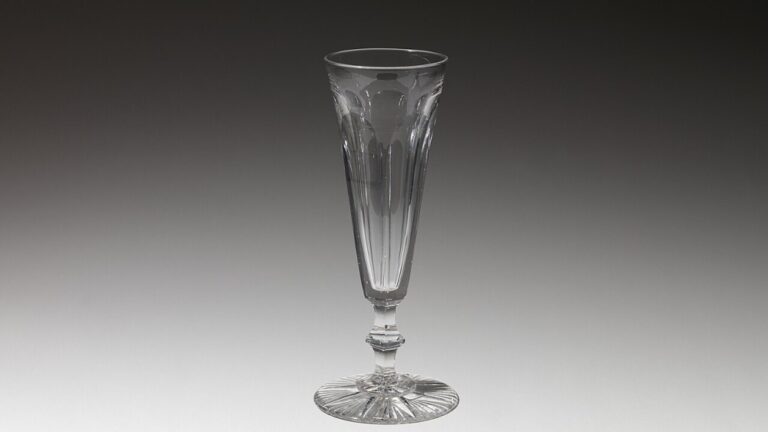
The Coupette is a stemmed glass with a V-shaped bowl, often confused with the cocktail coupe. In many bars, it has replaced the shallow champagne coupe as the standard glass for drinks like Daiquiri or Margarita. The name derives from the French word for “cup” but describes a distinct glass shape.
What defines the Coupette
The Coupette has a conical, upward-opening shape – in cross-section resembling a V or a shallow U. Its capacity is usually between 12 and 18 cl, with the bowl mounted on a slender stem. Unlike the flat champagne coupe, the Coupette tapers to a point and better retains aromas within the glass. Its rim is wide enough for salt rims or sugar garnishes, but the opening is narrower than that of a classic cocktail coupe.
In practice, there are gradual transitions: some manufacturers refer to any stemmed V-shaped glass as a Coupette, while others reserve the term for glasses with slightly rounded sides. The decisive factor is the silhouette – it resembles a tulip or an inverted cone, never a flat cup.
Use behind the bar
The Coupette is the workhorse for all Sours and short drinks served without ice. Daiquiri, Margarita, Cosmopolitan, Aviation – these classic cocktails are traditionally served in this glass. The stem prevents the drink from warming in the hand, and the shape optimally presents color and foam. When adding a salt or sugar rim, the Coupette provides enough surface area without the rim obstructing the drinker’s nose.
In many bars today, the Coupette has replaced the Martini coupe. The difference: the Martini coupe usually has steeper, straighter walls and is larger. The Coupette remains more compact and fits better in the hand. For drinks with plenty of foam – such as a Whiskey Sour with egg white – the V-shape offers enough space without the glass appearing bulky.
Common misconceptions
The biggest mistake: assuming Coupette and Coupe are the same. The Coupe is the shallow champagne coupe from the 1920s, while the Coupette has a conical shape. Both have stems, but the Coupe looks like a soup plate on a foot, while the Coupette resembles a pointed triangle. Aromas and carbonation dissipate faster from the Coupe, which is why it has fallen out of favor for champagne.
Differentiating between Coupette and Martini glass is also not always clear-cut. Rule of thumb: Martini glasses are larger (often over 20 cl), have steeper walls, and a longer stem. The Coupette remains smaller, more compact, and often features a slightly rounded line. In practice, many bars use both terms interchangeably – as long as the glass has a stem and the right size, it works.
Handling and care
The Coupette should always be pre-chilled – either in the freezer or filled with ice water while mixing the drink. A warm glass will immediately dilute the drink and rob it of its chill. After washing, hold the glass by the stem, not the bowl – fingerprints on the glass look unprofessional.
When pouring, tilt the glass slightly to allow foam to distribute evenly. The Coupette is more delicate than a tumbler: thin glass, long stem. Never stack glasses; always place them individually. Serve on a coaster or barboard so the guest can grip the glass securely.
Pair with
Frequently asked questions
Is a Coupette the same as a Martini glass?
No, even though both are often used interchangeably. The Coupette is smaller, has a more compact V-shape, and often slightly rounded walls. The Martini glass is larger, steeper, and has a longer stem. In practice, both work well for similar drinks.
Why does the Coupette have a stem?
The stem prevents the drink from warming in the hand. Cocktails served in the Coupette are ice-cold and served without ice – any heat source will cause them to dilute and lose temperature faster. Always hold the glass by the stem.
Can I serve champagne in a Coupette?
Technically yes, but it’s not ideal. The Coupette retains aromas better than the flat Coupe, but not as well as a flute. Carbonation dissipates faster than in a slender champagne flute. For champagne cocktails like the French 75, the Coupette works well.
How large should a Coupette be?
Between 12 and 18 cl is standard. Smaller glasses appear cramped, while larger ones make the drink look lost. Most classic short drinks fit perfectly in a 15 cl glass – enough room for foam without the glass appearing oversized.