Build in glass – or simply Building – is the most straightforward of all mixing techniques. You add all the ingredients directly to the serving glass, without a shaker or mixing glass. This method is perfect for drinks with carbonated ingredients or when you want to preserve the layers and texture in the glass. After this guide, you’ll master the technique and know exactly when to use it.
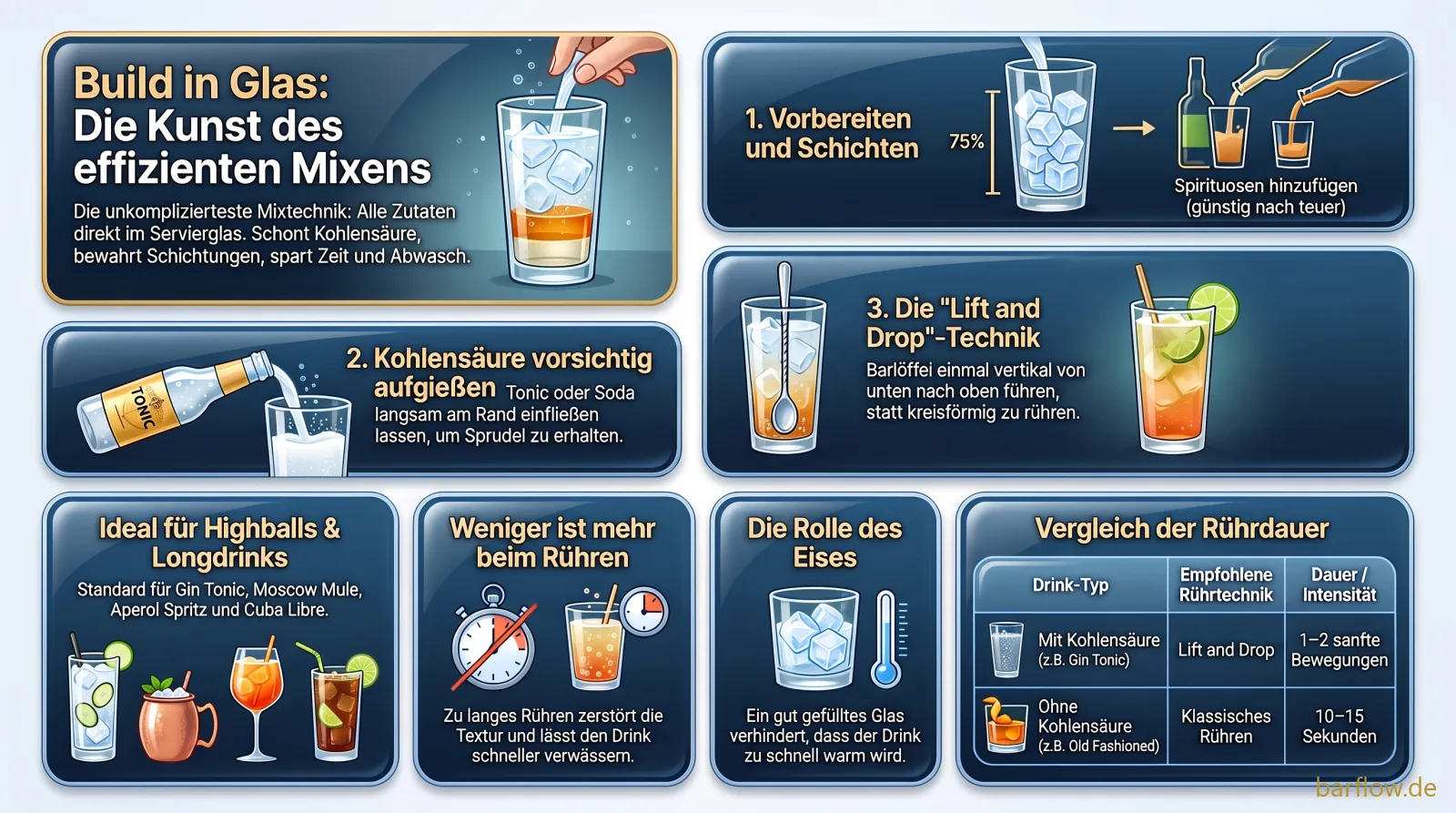 Enlarge graphic
Build in glass – or simply Building – is the most straightforward of all mixing techniques. You add all the ingredients directly to the serving glass, without a shaker or mixing glass. This method is perfect for drinks with carbonated ingredients or when you want to preserve the layers and texture in the glass. After this guide, you’ll master the technique and know exactly when to use it.
How to build a drink in the glass
- Fill the serving glass with ice – either ice cubes or crushed ice, depending on the drink. The ice should fill the glass about three-quarters full.
- Add the spirit(s) and other non-carbonated ingredients directly over the ice. Work in order from least expensive to most expensive or from smallest to largest quantity.
- Carefully add carbonated ingredients such as tonic, soda, or ginger beer. Pour them slowly along the edge of the glass to preserve the carbonation.
- Stir the drink briefly with a bar spoon – one to two gentle up-and-down movements are enough. Too much stirring dilutes the drink and drives off the carbonation.
- Garnish the drink and serve immediately with a straw or stirrer, if desired.
When to use Building
This technique is ideal for Highballs and long drinks: Gin & Tonic, Moscow Mule, Cuba Libre, Aperol Spritz – all of these are built in the glass. Even simple spirit mixes like Whisky Cola or Rum with ginger beer work best this way. The reason: carbonated mixers cannot tolerate shaking or vigorous stirring. Additionally, simple drinks with two or three ingredients don’t require elaborate mixing techniques. This saves time, reduces cleanup, and preserves the drink’s texture. For drinks without carbonation – such as an Old Fashioned – you also build in the glass, but stir a bit longer to achieve the right dilution.
Common mistakes when Building
The most common mistake when Building is stirring too forcefully or for too long. This destroys the carbonation and unnecessarily dilutes the drink. Many bartenders also add carbonated ingredients too quickly or from too great a height, which causes the carbonation to escape immediately. Another beginner error is using too little ice. The glass should be well filled, otherwise the drink will warm up and become watery too quickly. The order of ingredients is also important: always add carbonated mixers last, otherwise you’ll lose the fizz when adding other ingredients afterward.
Bartender detail: the right stirring technique
Professionals don’t stir in circular motions when Building, as they would with classic stirring. Instead, they use the bar spoon in a single vertical motion from bottom to top – known as Lift and Drop. This gently mixes the ingredients without disturbing the carbonation. The spoon enters at the edge of the glass, travels to the bottom, lifts the lower layer upward, and then withdraws. One to two repetitions are sufficient. For drinks without carbonation, such as an Old Fashioned, you may stir longer – about 10 to 15 seconds – to achieve the right dilution and chill.
Related
- Shake vs. Stir – when to use which technique
- Stirring – the art of stirring in the mixing glass
Frequently asked questions
Why are some drinks built in the glass instead of being shaken?
Carbonated mixers like tonic or soda should not be shaken – they would immediately lose their gas and the drink would overflow. Moreover, many long drinks are so simple that shaking or stirring in a separate vessel offers no advantage. Building saves time and equipment, and the guest can watch their drink being made.
Do I always need to stir when Building?
For most drinks, yes, but only briefly. One or two gentle stir movements from the bottom upwards are enough to mix the ingredients. Some bartenders deliberately leave drinks like Gin Tonic unstirred and leave the mixing to the guest – that’s a matter of taste. Important: Never stir too vigorously, otherwise you’ll lose carbonation and create too much dilution.
Which drinks are typically built in the glass?
All highballs and longdrinks with carbonation: Gin Tonic, Moscow Mule, Cuba Libre, Aperol Spritz, Whisky Cola, Dark and Stormy. Even simple drinks without carbonation like Old Fashioned, Negroni (sometimes) or Americano are often built directly in the glass. The rule of thumb: If the drink contains carbonation or only two to three ingredients, building is usually the right choice.
Can I also build drinks with fruit juice in the glass?
Yes, as long as there is no cream, egg white or thick syrups involved that require intense shaking. A simple Screwdriver (Vodka-Orange) or a Tequila Sunrise can easily be built in the glass. For drinks with citrus and syrup – such as a Tom Collins – many bartenders first shake the non-carbonated ingredients, then pour them into the glass and top with soda. This is a hybrid method.
How much ice do I need when building?
The glass should be filled to about three quarters with ice – in highball glasses often almost to the rim. Plenty of ice keeps the drink cold for longer and ensures controlled dilution. Too little ice will quickly make the drink warm and watery. With crushed ice, fill the glass completely because it melts faster and takes up more volume.