Behind every good bar lies more than just spirits and ice. The right tools make the difference between an average drink and one mixed with precision. Those aiming to work professionally need a basic set of equipment that functions reliably and withstands daily stress. Here you’ll learn which tools are truly essential and what to look out for when choosing them.
 Enlarge graphic
The Shaker Family
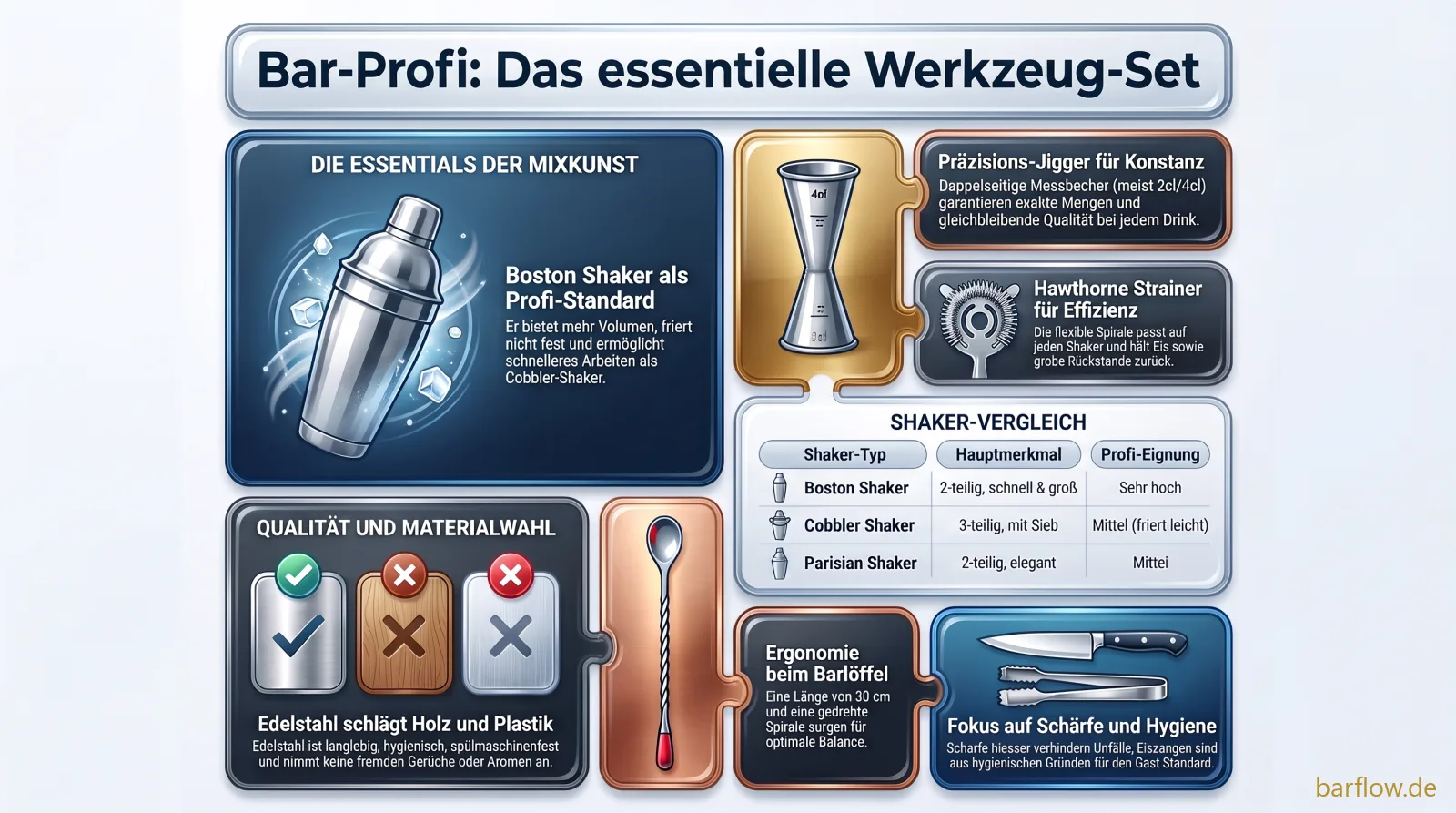
The shaker is the heart of any bar. There are three main types: the three-piece Cobbler shaker with an integrated strainer, the two-piece Boston shaker made of metal part and glass or metal-on-metal, and the French Parisian shaker. In practice, the Boston shaker has prevailed because it’s quick to open, offers a larger volume and doesn’t freeze shut. The Cobbler may look elegant, but it tends to jam, especially when cold. Professionals almost always use the Boston because speed matters and you can’t afford to wrestle with a frozen lid during a busy service.
When it comes to shakers, material matters. Stainless steel doesn’t rust and lasts forever. Weighted shakers with a thicker base sit better in the hand but cost more. A good shaker must seal tightly but not be too tight to open. It should open with a precise strike on the right spot—not brute force.
Strainers
No shaken or stirred drink reaches the glass without a strainer. The Hawthorne strainer with its spiral fits onto the shaker and holds back ice and larger pieces. The fine Julep strainer, originally designed for Mint Juleps, is now mainly used when stirring in a mixing glass. For drinks that need to be absolutely clear, the Fine Strainer comes into play—a small tea strainer that catches even tiny ice shards and fruit fibers.
When choosing a Hawthorne strainer, make sure the spiral is firmly attached and doesn’t wobble loosely. Cheap models lose their spiral after just a few weeks. The ears for holding should be sturdy, not stamped from thin sheet metal. A good strainer costs between ten and twenty euros and lasts for years.
Jiggers and Measuring Tools
Precision begins with measurement. The jigger is a double-sided measuring cup, traditionally with 2 cl and 4 cl, sometimes 3 cl and 5 cl. Japanese jiggers often feature markings for intermediate values and a narrower, taller shape that allows more accurate reading. In hectic nights, every move counts, so the jigger should sit comfortably in the hand and be easy to read at a glance.
Some bartenders swear by free-pouring with pour spouts, but it requires practice and leads to inconsistencies. Especially with expensive spirits or complicated recipes, the jigger is indispensable. A good compromise is a jigger with internal markings so you don’t have to fill it to the brim.
Bar Spoons and Stirring Technique
The bar spoon is long, usually with a twisted spiral on the handle and often a small scoop or pestle at the end. It’s used for stirring drinks in a mixing glass, for carefully layering, and for measuring small amounts. A standard bar spoon holds about 5 ml, or one teaspoon. The spiral isn’t just decorative—it sits comfortably between the fingers when stirring and helps rotate the spoon evenly.
When buying, pay attention to weight and balance. Too light spoons flutter while stirring; too heavy ones tire the hand. The length should be at least 30 cm so you can work in tall mixing glasses. Stainless steel is standard, though some swear by gold-plated or copper-colored versions—taste-dependent, as long as the function is right.
Muddlers and Pestles
For Mojitos, Caipirinhas and Old Fashioneds, you need a muddler. This is a pestle made of wood, plastic or stainless steel, with which you crush fruits, herbs and sugar in the glass. Wood is traditional and looks good but needs to be maintained and absorbs odours. Plastic is more hygienic and dishwasher-safe. Stainless steel is robust but can scratch glasses if you work too roughly.
The shape makes the difference: flat, toothed ends are good for fruits, smooth ends for herbs that you only want to press lightly, not crush. A good muddler fits securely in the hand and is heavy enough that you don’t have to use force. A length of around 20 cm is ideal for standard glasses.
Knives, peelers and cutting tools
Garnishes and zests are part of many drinks. A sharp paring knife with a short blade is essential for citrus fruits and cutting work. A zester or channel knife, with which you cut long, thin spirals from the peel, is also needed. A Y-peeler is good for wide, thin zests, such as a lemon zest over a Martini.
Sharpness is everything. A dull knife slips and is dangerous. Invest in decent blades and keep them sharp. A small sharpening stone or honing steel behind the bar saves time and nerves. Plastic cutting boards are more hygienic than wood and can be washed in hot water.
Mixing glass
Stirred drinks like Martini, Manhattan or Negroni are mixed in a mixing glass. This is a heavy, thick-walled glass, often with a spout, in which you stir the ingredients with ice until they are cold and diluted. Japanese mixing glasses are particularly well-crafted, with engraved patterns and precise spouts. Volume is important – at least 500 ml, better 600 ml or more, so you can use enough ice.
The glass should be heavy enough to stand stably while stirring but not so heavy that you can’t hold it comfortably. Some models have a silicone ring on the base to prevent slipping. A good spout prevents dripping and enables precise pouring. Cheap mixing glasses are often too thin-walled and heat up too quickly.
Ice tongs, ice scoop and ice spoon
Handling ice by hand is unprofessional and unhygienic. A stainless steel ice tong with serrated ends securely picks up cubes. For crushed ice or larger quantities, an ice scoop is more practical. Some bartenders use a large spoon to lift ice from the tub – the main thing is to keep hands out of it.
Make sure the tongs or scoop are not left in the ice. The tool should have a fixed place, be kept dry and clean. Stainless steel is better than plastic as it does not discolour or absorb odours. A good ice tong balances well in the hand and does not tire after a hundred drinks per night.
Citrus juicer and presses
Fresh juice makes all the difference. Hand lever presses made of cast iron or stainless steel are robust and efficiently extract juice from lemons, limes and oranges. Mexican elbow juicers are quick and space-saving but require strength. Electric presses only make sense for very high volumes.
It’s important that the press is easy to clean. Fruit pulp and seeds can get stuck in crevices. Models with removable parts are more practical. Some bartenders swear by simple wooden hand presses – they work but are slower. In a well-organised bar, you press juices before service and store them chilled, so you only need to top up during service.
Pourers and spouts
Pourers are attached to bottles and control the flow. There are free-pour spouts without dosing and measured pourers that dispense a fixed amount. Free pouring requires practice and counting – a steady flow and an internal rhythm give the right amount. Measured pourers are more accurate but slower and sometimes unreliable.
In Germany, free-pour spouts are less common than in the US because metrology laws require precise quantities. Nevertheless, many bars use pourers for syrups, liqueurs and other non-spirits. Important: clean them regularly, otherwise they clog. Stainless steel pourers are more durable than plastic but cost more.
Common misconceptions
Many believe that expensive tools automatically make better drinks. Not true. A cheap Boston shaker works just as well as a hand-crafted Japanese model, as long as it seals tightly and can be opened. More important than price is that you can work with the tool and it suits your style.
Another misconception: you need every tool in triplicate. In a quiet bar, one set is enough. Only at high volume or with multiple bartenders working simultaneously do duplicates make sense. It’s better to buy decent quality once than cheap junk three times over.
Some think wooden tools are more hygienic than plastic. The opposite is true. Wood absorbs moisture and odours; plastic and stainless steel can be washed in hot water and disinfected. Wood has its place, such as muddlers, but not for hygienic reasons, rather for the feel.
Related
Frequently Asked Questions
Which shaker is best for beginners?
The Boston Shaker is the most practical. It opens quickly, holds enough volume for two drinks at once and doesn’t freeze shut. The Cobbler Shaker may look elegant, but it often jams, especially when you don’t yet have much experience. With the Boston you’ll learn the right technique and can always switch later if you want.
Do I really need a jigger or can I pour freehand?
Freehand pouring looks professional but requires practice and leads to inconsistencies. Especially at the start and with expensive spirits, the jigger is indispensable. Even experienced bartenders use it for complex drinks or when precision counts. You can learn both, but start with the jigger.
How often do I need to replace my bar tools?
Good stainless steel tools last for years, sometimes decades. You only need to replace them if they’re damaged – bent strainers, loose springs on the Hawthorne strainer or dull knives that can’t be sharpened anymore. Wooden muddlers and cutting boards wear out faster. Check regularly for cracks and wear, especially on heavily used parts.
What is the difference between cheap and expensive jiggers?
Expensive jiggers often have more precise interior markings, better craftsmanship and a more balanced feel in the hand. Japanese models are slimmer and allow for more accurate readings. Cheap jiggers work just as well as long as the measurements are correct. The difference lies in feel and durability, not function. For beginners, a solid mid-range model is sufficient.
Can I use regular kitchen tools instead of bar tools?
Partly yes. A sharp kitchen knife can replace the paring knife, a tea strainer can serve as a fine strainer. But specialized tools like the Hawthorne strainer, bar spoon or muddler have no good kitchen equivalents. A cooking spoon is too short for stirring, a regular sieve doesn’t fit on the shaker. Invest in the most important bar-specific tools and supplement with kitchen tools where it makes sense.