
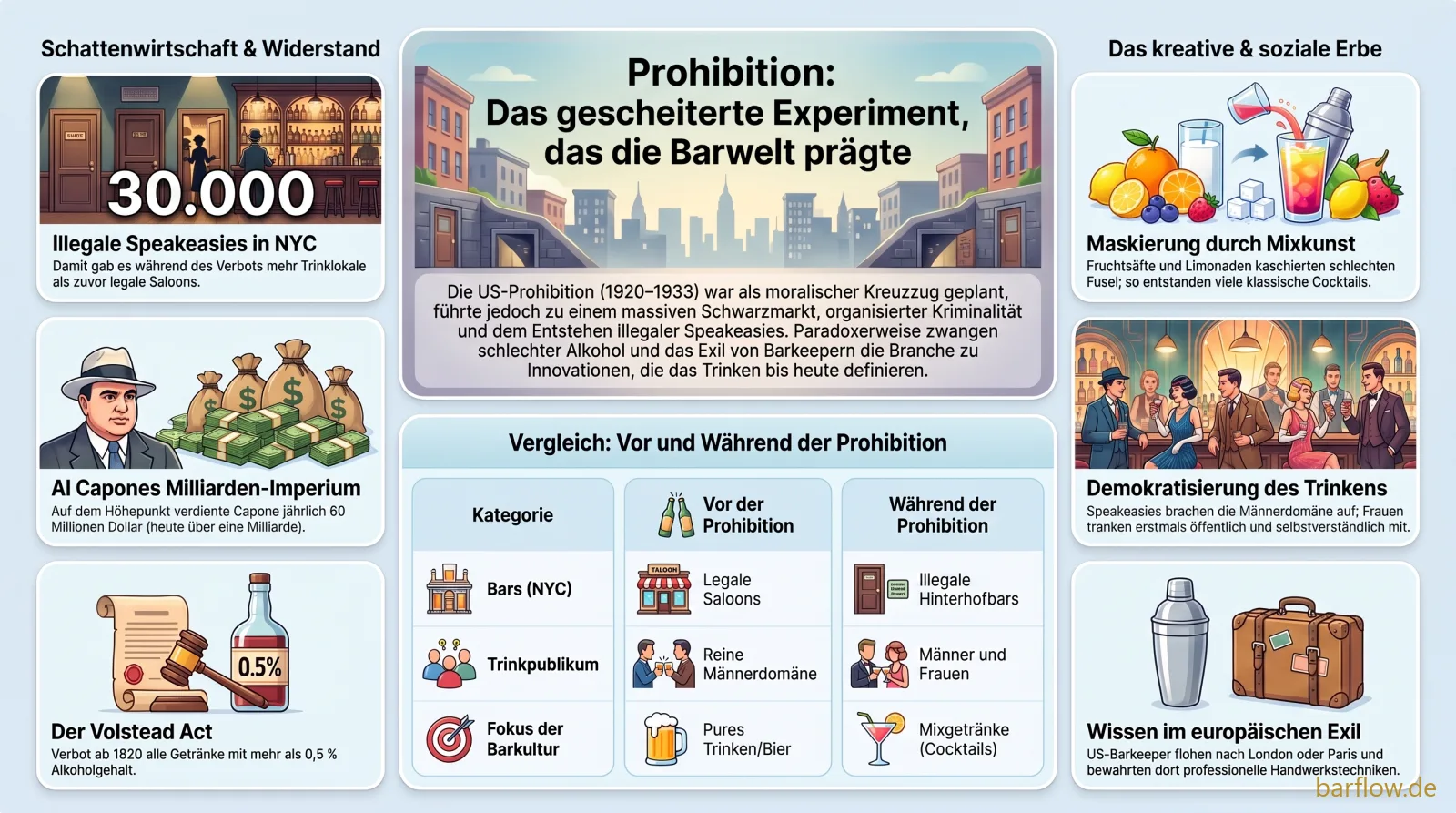
From 1920 to 1933, the United States had a nationwide ban on the production, sale, and transportation of alcoholic beverages. Prohibition was intended to improve society but instead achieved the opposite: organized crime flourished, illegal bars popped up everywhere, and bartenders fled to Europe. What began as a moral crusade ended as a failed experiment—and left traces that can still be found in every cocktail bar today.
 Enlarge graphic
The Road to Prohibition
The Prohibition movement had its roots in the 19th century. Religious groups, particularly the Temperance Movement, blamed alcohol for social ills like domestic violence, poverty, and crime. The Anti-Saloon League, founded in 1893, exerted systematic pressure on politicians. State by state, local bans were introduced until the 18th Amendment was ratified in 1919.
The Volstead Act, named after Congressman Andrew Volstead, defined how Prohibition would be implemented. From January 17, 1920, the sale of beverages with more than 0.5 percent alcohol was illegal. Strictly speaking, consumption itself remained legal, but without legal sources, the law amounted to a total ban in practice. Supporters believed in a new era of morality and productivity. Reality turned out differently.
Speakeasies and the New Bar Culture
Illegal drinking establishments, known as Speakeasies, sprang up across the country almost overnight. The name came from the need to speak quietly to avoid drawing police attention. Entry required hidden doors, passwords, or personal recommendations. Some Speakeasies hid behind laundries or florists, while others were tucked away in basements or attics. Estimates suggest that at one point there were over 30,000 such venues in New York City—more than before Prohibition.
The quality of the available alcohol was often poor. Smuggled whiskey from Canada or the coast was expensive and scarce. Most people drank bathtub gin, homemade spirits, or industrial alcohol hastily made palatable. Bartenders had to be inventive: they masked the harsh taste with fruit juices, sodas, and whatever was on hand. Many classic cocktails considered refined today originated from the necessity to make bad alcohol drinkable.
Paradoxically, Prohibition democratized drinking. Before, saloons were male-only domains. Speakeasies, however, attracted both genders, and women drank publicly and naturally for the first time. Jazz, new dance styles, and an atmosphere of rebellion defined Speakeasy culture. The ban didn’t just make drinking illegal—it made it exciting.
Organized Crime and Smugglers
Prohibition created a massive black market, and criminal organizations filled the gap. Figures like Al Capone in Chicago, Lucky Luciano in New York, or the Purple Gang in Detroit built empires on alcohol smuggling. At its peak, Capone is said to have earned $60 million a year—equivalent to over a billion dollars today.
The smuggling took various routes. Rumrunners brought whiskey from Canada and the Caribbean across borders and coasts. Distilleries in Canada and the Bahamas operated at full capacity, officially for export to other countries but in reality for the US market. Off the East Coast, a fleet of ships lay beyond the 12-mile limit, the so-called Rum Row, from which smaller boats brought alcohol ashore. The Coast Guard was hopelessly overwhelmed.
Violence escalated. Gang wars over territories claimed thousands of lives; the infamous Valentine’s Day Massacre of 1929 in Chicago was just the most notorious case. Corruption seeped through every level: police officers, judges, and politicians took bribes. The law, meant to improve society, permanently undermined trust in state institutions.
Exiled Bartenders
For professional bartenders, Prohibition meant the end of their legal livelihood. Many of the best left the country. Harry Craddock, who later wrote The Savoy Cocktail Book, went to London’s Savoy Hotel. Harry MacElhone took over Harry’s New York Bar in Paris. In Havana, London, Paris, and other European cities, bars run by American bartenders serving American cocktails began to appear.
This emigration had far-reaching consequences. European bar culture, which until then had focused more on wine and beer, absorbed the American cocktail tradition. At the same time, these exiled bartenders preserved standards and techniques that were lost in the U.S. itself. When Prohibition ended, much of this institutional knowledge had vanished. It would take decades to rebuild it.
The End and Its Aftermath
The Great Depression of 1929 hastened Prohibition’s demise. The government desperately needed tax revenue, and the legal alcohol industry promised jobs. Public opinion turned, even among former supporters, who saw the experiment as a failure. On December 5, 1933, the 21st Amendment was ratified—the only one to repeal a previous amendment.
The return to legality was bumpy. Many states and counties introduced their own regulations; some remained dry. Organized crime didn’t disappear—it simply shifted to other fields. The bar culture took decades to recover. It wasn’t until the 1990s that a renaissance began, as bartenders rediscovered old techniques and recipes.
Yet Prohibition left positive traces as well. The creativity bartenders had to employ to mask poor-quality ingredients led to new drinks and techniques. The democratization of drinking persisted. And the romance of the Speakeasy era continues to inspire bar concepts worldwide. The failed experiment became the founding legend of modern cocktail culture.
Also check out
- Gin Rickey
- Southside
Frequently Asked Questions
Why is Prohibition linked to cocktail culture?
Prohibition forced bartenders to mask the harsh flavors of bootleg alcohol with juices, syrups, and other ingredients. Many of today’s classic cocktails were created or refined during this time. Meanwhile, professional bartenders emigrated to Europe, spreading American cocktail culture there. The illegal Speakeasies also created an atmosphere of rebellion and glamour that still shapes bar concepts today.
How many Speakeasies were there during Prohibition?
Exact numbers are impossible to verify, since the venues were illegal. Estimates suggest that at its peak, New York City alone had over 30,000 Speakeasies—far outnumbering the legal bars before Prohibition. Other major cities saw similar figures. The ban didn’t reduce the number of drinking spots; it simply drove them underground.
Was Prohibition enforced uniformly across America?
No, enforcement varied widely. Rural areas and conservative regions took the ban seriously, while cities like New York, Chicago, or San Francisco found it largely ineffective. Corruption and limited resources made enforcement difficult. After 1933, many states and counties introduced their own rules, and some still enforce local alcohol bans today.
What role did Canada play during Prohibition?
Canada became the primary legal source of alcohol. Its distilleries produced officially for export, but most of the output was smuggled into the U.S. via routes like Detroit and the Great Lakes. Large quantities also entered from British Columbia’s coast. The Canadian government benefited from tax revenue and jobs while maintaining official neutrality.
