
Japan has a drinking culture that has developed over centuries and is far more than mere alcohol consumption. From ceremonial Sake drinking to modern Izakaya visits, tradition, social codes, and craftsmanship come together. Drinking here is not just about enjoyment but serves as a tool for strengthening social bonds and relaxation in a highly formalized society.
 Enlarge graphic
Sake – the drink of the gods
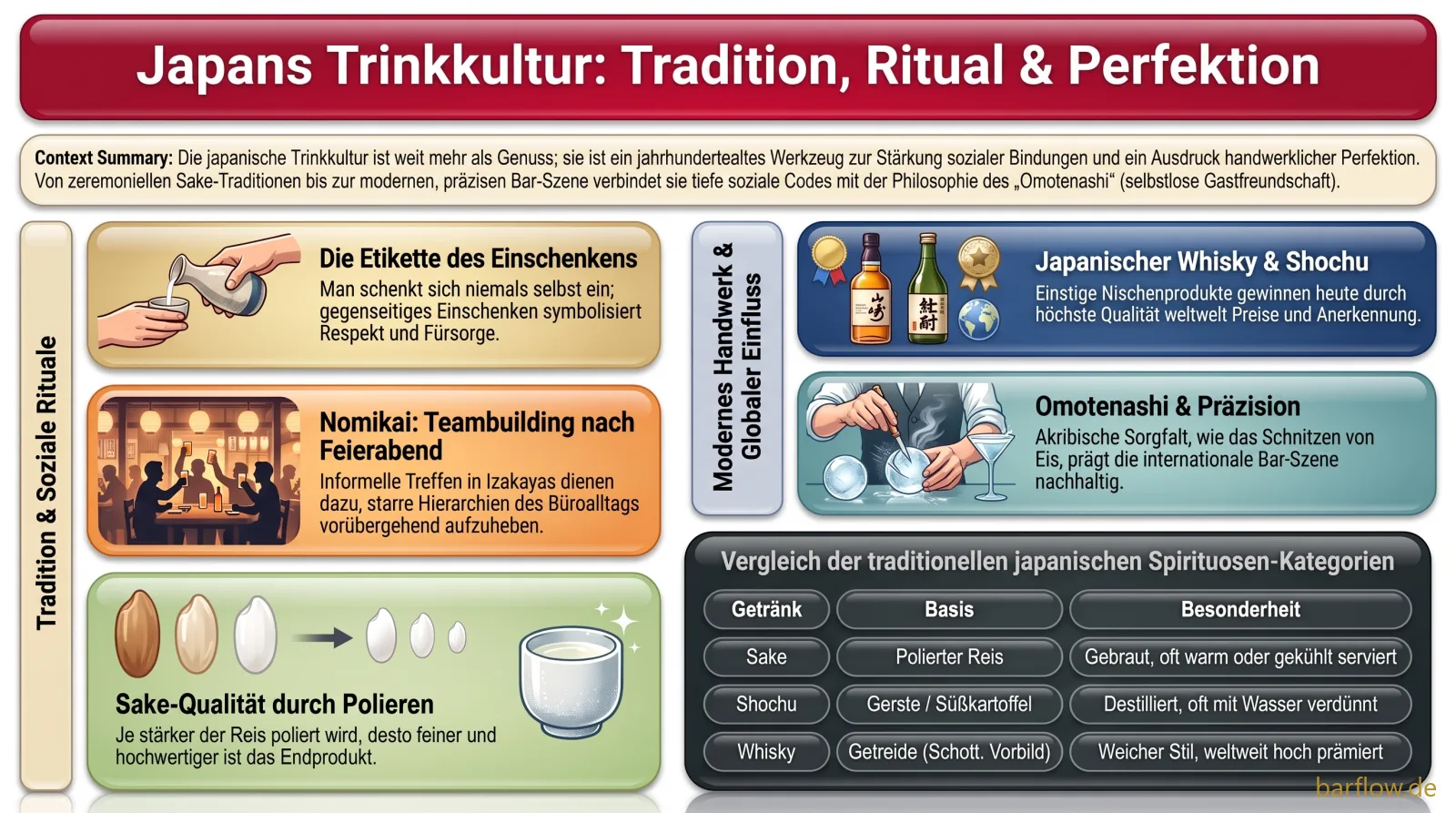
Sake, the rice wine brewed from polished rice, has been at the heart of Japanese drinking culture for over a thousand years. Originally brewed in Shinto shrines and offered to the gods, it later became the drink of the nobility and then the general population. The production follows strict rules: the rice is milled, washed, steamed, and fermented with koji mold. The more the rice is polished, the finer and more expensive the sake.
Traditionally, sake is drunk from small ceramic cups called Ochoko, served on flat wooden trays called Masu. When drinking together, the rule is to pour for others—never for yourself. This gesture expresses respect and care and strengthens social bonds. Sake is served warm or cold depending on the variety, with high-quality types usually chilled to preserve delicate aromas.
Nomikai and the role of alcohol in working life
In Japanese business culture, the Nomikai—after-work drinking gatherings—plays a central role. These informal meetings in Izakayas—Japanese pubs—help soften hierarchies and enable honest conversations that would be unthinkable in the strictly formal office environment. Under the influence of alcohol, people can say things that would otherwise be considered rude, without facing consequences the next day.
The ritual often begins with a shared Kanpai, the Japanese equivalent of “Cheers.” Younger colleagues pour for their seniors, and it is considered rude to fill one’s own glass. This drinking culture is so deeply rooted that refusing can be difficult—those who don’t drink usually need a good reason. In recent years, however, awareness of the problems of excessive alcohol consumption has grown, and alcohol-free alternatives are increasingly accepted.
Shochu, Whisky, and the modern bar scene
Alongside sake, Shochu—a distilled spirit made from barley, sweet potatoes, or rice—has a long tradition, especially in southern Japan. Shochu is stronger than sake and is often diluted with hot water or served on the rocks. Once considered a drink of the common people, it has experienced a renaissance since the 1990s and is now appreciated even in upscale bars.
Japanese Whisky has undergone remarkable development since the 1920s. Inspired by Scottish methods, distilleries like Yamazaki and Nikka developed their own, often softer style. Since the 2000s, Japanese whisky has gained international recognition and awards. In the bars of Tokyo, Osaka, and Kyoto, it is served with great respect, often neat or with a single large ice cube to slowly release the aromas.
The modern Japanese bar scene combines Western cocktail artistry with Japanese precision and hospitality. Bartenders work with meticulous care, every movement deliberate, every ingredient carefully chosen. This attitude, called Omotenashi—the art of selfless hospitality—shapes the experience behind the bar and makes Japanese cocktail bars worldwide models of craftsmanship and dedication.
What remains of this in the bar
Japanese drinking culture has had a lasting impact on the international bar scene. The principle of perfection in detail, the calm and concentration during preparation, and respect for ingredients are now appreciated worldwide. Japanese techniques such as precise stirring, ice carving, or the use of umami-rich ingredients can be found in cocktail bars from New York to London.
Sake and Shochu have also found their way into modern drinks. Bartenders experiment with Sake in Martini variations or use Shochu as a base for light, aromatic cocktails. Japanese Whisky has long been a staple in premium spirit shelves. The attitude that drinking is a communal, respectful ritual inspires bartenders worldwide to not only serve their guests but to offer them an experience that goes beyond the glass.
Related
Frequently Asked Questions
What is the difference between Sake and Shochu?
Sake is a brewed beverage made from fermented rice with about 15–20 percent alcohol, similar to wine. Shochu, on the other hand, is distilled, can be made from various base ingredients such as barley, sweet potatoes, or rice, and has an alcohol content of 25–35 percent.
Why don’t people pour drinks for themselves in Japan?
Pouring for others is a gesture of respect and care. It strengthens social bonds and shows consideration for others. Pouring for oneself is considered impolite and selfish.
How do you drink Sake correctly?
High-quality Sake is usually served chilled in small ceramic cups to preserve its delicate aromas. Simpler Sake can also be enjoyed warm. The important thing is to savor the Sake slowly and pour for one another.
What makes Japanese bars so special?
Japanese bars are distinguished by extreme precision, calm, and the philosophy of Omotenashi – selfless hospitality. Every ingredient, every movement, and every detail is handled with the utmost care to provide the guest with a perfect experience.
