
After water, tea is the most widely consumed drink in the world, and its history dates back over 5,000 years. Long before it was served in European salons, it was medicine, a commodity, and a cultural asset in China all at once. Tea only became interesting for bartenders in the 20th century, when cold tea cocktails and punches supplemented the classic spirits bar. Today, tea is experiencing a renaissance in mixology that goes far beyond simple iced tea.
 Enlarge graphic
Origin and early spread
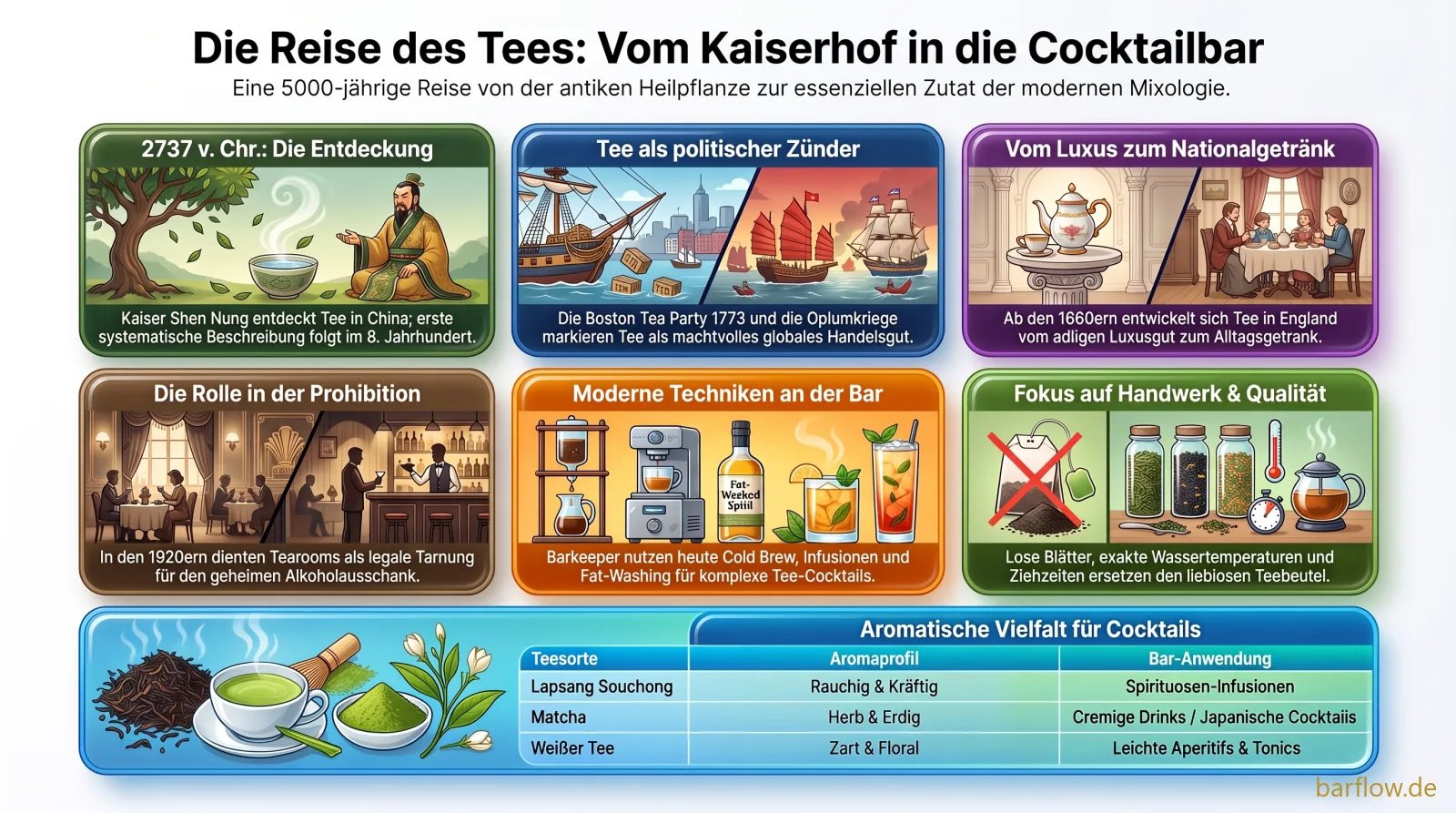
The legend attributes the discovery of tea to the Chinese Emperor Shen Nung, who is said to have lived around 2737 BCE. Historically, it is certain that tea was cultivated and drunk in China by at least the Han Dynasty (206 BCE to 220 CE). Initially valued as a medicinal remedy, tea drinking evolved into an art form that reached its first peak during the Tang Dynasty (618–907). In the 8th century, the scholar Lu Yu wrote the Cha Jing, the classic book of tea, which systematically described cultivation, preparation, and ceremony.
Through the Silk Road and Buddhist monks, tea reached Japan, where its own tea culture developed from the 12th century onward. The Japanese tea ceremony, Chanoyu, became a meditative practice that combined aesthetics, philosophy, and social etiquette. Tea only arrived in Europe in the 17th century, brought by Dutch and Portuguese traders. England made it a national drink from the 1660s, initially as an expensive luxury item for the nobility, later as an everyday drink for all social classes.
Tea as a commodity and political factor
The tea trade changed the world economy. In the 18th century, the British East India Company controlled imports to Europe and made enormous profits. To offset trade deficits with China, Britain exported opium from India to China, leading to the Opium Wars (1839–1842 and 1856–1860). These conflicts violently opened China to Western trade and had far-reaching political consequences.
The famous Boston Tea Party of 1773 was a direct protest against British tea taxes and is considered the trigger for the American Revolution. Tea was therefore not only a beverage but also an instrument of power and a symbol of political conflict. In the 19th century, the British began growing tea in their colonies of India and Ceylon (now Sri Lanka) to reduce dependence on China. Assam and Darjeeling became world-famous growing regions.
Tea in the bar
In the classic bar culture of the 19th century, tea initially played no major role. Punches, which often contained tea, were already popular in England and the American colonies in the 18th century, but were usually served at private gatherings, not in public bars. It was not until the Prohibition era in the USA (1920–1933) that tea gained significance: tea rooms became legal meeting points where alcohol was secretly served as well.
After World War II, bartenders increasingly experimented with tea as an ingredient. The Long Island Iced Tea, despite its name not containing actual tea, is believed to have originated in the 1970s and became a symbol of strong, sweet mixed drinks. At the same time, an independent cocktail culture developed in Asia that combined traditional tea varieties with spirits. In Japan, for example, Matcha and Sencha were integrated into drinks long before this became fashionable in the West.
Since the 2000s, tea has been reassessed in the premium bar scene. Bartenders use high-quality tea varieties for infusions, syrups, and fat-washing. Cold tea, prepared as Cold Brew, delivers complex aromas without bitterness. Tea tonics and alcohol-free tea cocktails have also become established, as they provide depth and structure without relying on spirits. Tea is no longer seen merely as a filler but as a full-fledged flavor carrier with its own distinctive profile.
What remains in the bar
The millennia-old tea culture has left the bar with one thing above all: respect for the ingredient. While tea was once often carelessly brewed from bags, modern bartenders work with loose leaves, paying attention to water temperature and steeping time. The variety of teas – from delicate white tea to smoky Lapsang Souchong to fermented Pu-Erh – opens up a broad spectrum of aromas that can be used purposefully.
Even the ceremonial dimension of tea finds its way behind the bar. The conscious, calm preparation central to the Japanese tea ceremony inspires bartenders who value craftsmanship and presentation. Tea thus bridges tradition and innovation: it is historically rooted while remaining open to new interpretations. At a time when guests increasingly ask for alcohol-free alternatives, tea offers a depth of flavor that goes far beyond soft drinks.
Perfect pairings
- Punch
- Long Island Iced Tea
Frequently asked questions
Since when has tea been used in cocktails?
Tea was already part of punches consumed in England and the American colonies in the 18th century. In modern bar culture, tea only gained significance from the 1970s onwards, but has experienced a renaissance in high-end mixology since the 2000s.
Which teas are particularly suitable for cocktails?
Fundamentally, all teas can be used, depending on the desired flavor profile. Black tea like Earl Grey or Assam offers bold, malty notes, green tea like Sencha or Gunpowder brings freshness and grassiness, while oolong falls in between. Smoky Lapsang Souchong, floral jasmine, or earthy Pu-Erh open up further possibilities.
Why is the Long Island Iced Tea called that when it contains no tea?
The name plays on the appearance: the drink looks like iced tea but contains a mix of several spirits and cola. The term was presumably meant to appear harmless, even though the cocktail is very high in alcohol.
How to best prepare tea for cocktails?
For cold drinks, cold brew is recommended: let tea steep in cold water for several hours. The result is less bitter and aromatically clearer. Alternatively, tea can be brewed hot, cooled, and then used. It’s important to pay attention to water temperature and steeping time to avoid bitterness.
