
For centuries, matcha was a drink reserved for monks and tea ceremonies, strictly ritualized and far removed from anything to do with alcohol. It wasn’t until the last two decades that the vibrant green powder crossed the borders of Japan and into Western bars. What was once a spiritual practice became a trendy ingredient in mixology – and this has more to do with than just color and Instagram.
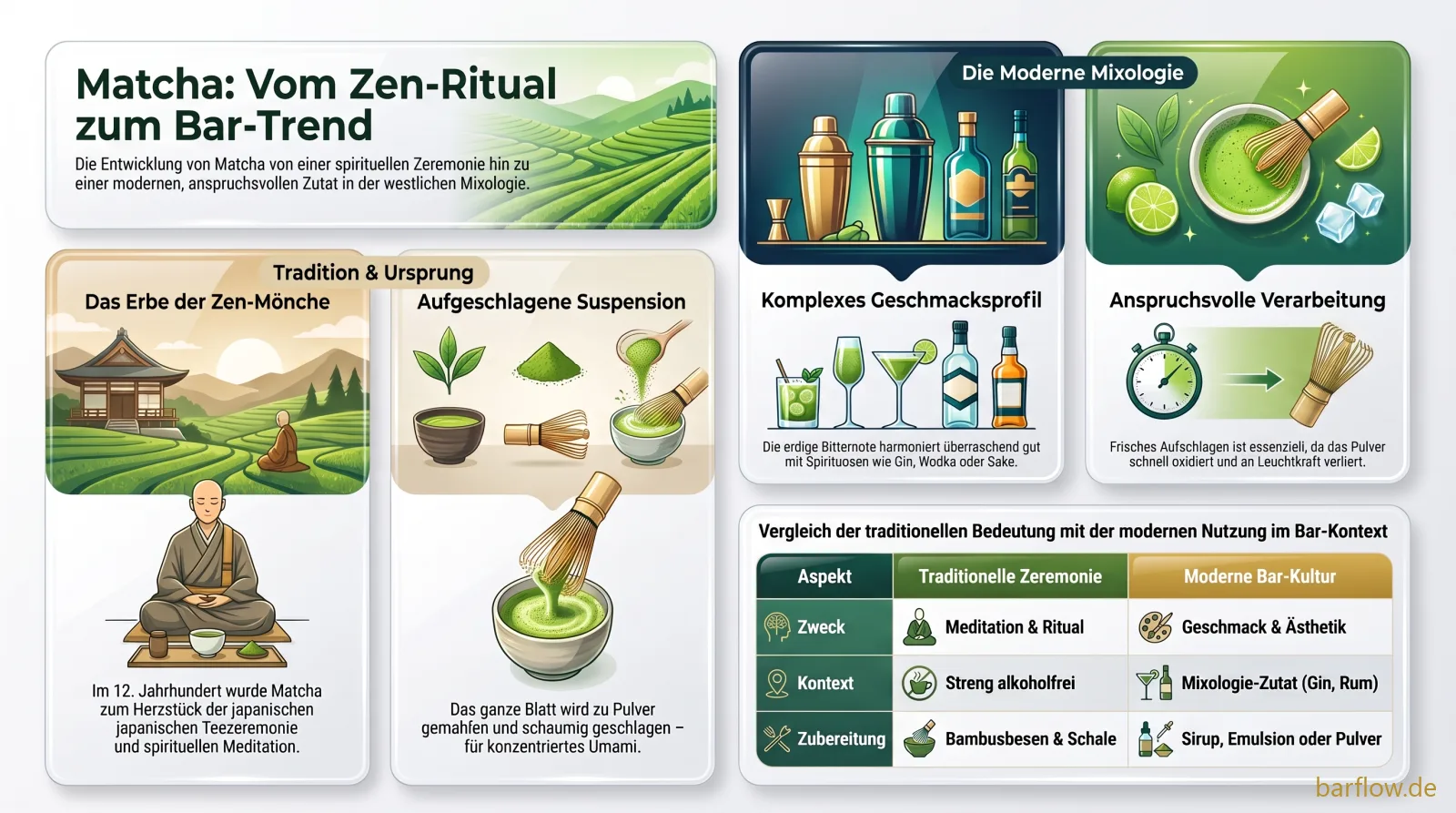 Enlarge graphic
Origin and Tradition
Matcha originated in China, where powdered tea was already consumed during the Tang Dynasty. Japanese Zen monks brought it to Japan in the 12th century, where it became the cornerstone of the tea ceremony. Unlike steeped tea, matcha is made by grinding the entire leaf into a fine powder and whisking it with hot water. The result is not an infusion but a suspension – concentrated, bitter, caffeinated, and packed with umami.
The preparation followed strict rules: the bowl, bamboo whisk, temperature, and motion were all codified; nothing was left to chance. Matcha was meditation, not enjoyment in the Western sense. And alcohol had no place in this context.
The Journey into Western Cuisine
Until the 1990s, matcha remained largely unknown outside Japan. It wasn’t until growing interest in Japanese culture, wellness, and healthy eating that the green powder began appearing in Western metropolises. Coffee shops offered matcha lattes, bakeries baked with it, and smoothie bars mixed it into their drinks. The taste was an acquired one for many, but the color and image – natural, energizing, exotic – turned matcha into a lifestyle ingredient.
At the same time, the cocktail scene experienced its renaissance. Bartenders sought new flavors beyond citrus and herbs. Matcha offered both visual impact and a bold, earthy note that surprisingly complemented spirits. Gin, vodka, sake, and even whisky could be paired with it.
Matcha Behind the Bar
In cocktails, matcha usually appears as a syrup, a whisked emulsion, or directly as a powder. The challenge lies in dosing: too much, and the drink turns bitter and dull; too little, and the color remains pale, the flavor disappears. Good matcha is expensive, while inferior quality tastes grassy and flat. Bartenders working with matcha must whisk the powder fresh and process it quickly, or it oxidizes and loses its vibrancy.
Despite these hurdles, matcha has established itself in many bars. It pairs well with floral notes like elderflower or jasmine, citrus, light rum, and sake. Often, it’s combined with milk or cream to soften the bitterness. In Japan itself, the combination of matcha and alcohol remains unusual – most matcha cocktails are created in New York, London, or Berlin.
What Remains Behind the Bar
The rise of matcha in cocktail culture is an example of how ingredients break free from their original context and take on new meanings. What was once ritual is now technique. What meant meditation is now flavor. This is neither good nor bad, but it shows how flexible cocktail culture is with traditions.
Matcha remains a demanding ingredient. It requires care, knowledge, and quality. Those who use it only for the color will be disappointed. But those who understand its nuances can craft drinks that are more than just green.
Related Topics
- Sake
- Gin
Frequently Asked Questions
Where does matcha originally come from?
Matcha has its roots in China, but was brought to Japan by Japanese Zen monks in the 12th century, where it became the foundation of the tea ceremony.
Why has matcha become so popular in cocktails?
Matcha offers an unusual combination of vibrant color, herbal flavor and cultural image. In modern mixology, it pairs well with floral and citrus notes as well as spirits like Gin, Vodka or Sake.
Is Matcha difficult to work with behind the bar?
Yes. Good Matcha is expensive, oxidizes quickly and must be freshly whisked. The dosage is crucial – too much makes the drink bitter, too little neither provides color nor flavor.
Are there Matcha cocktails in Japan, too?
In Japan, the combination of Matcha and alcohol is unusual. Most Matcha cocktails are created in Western metropolises, where bartenders are more free to experiment with traditions.
