
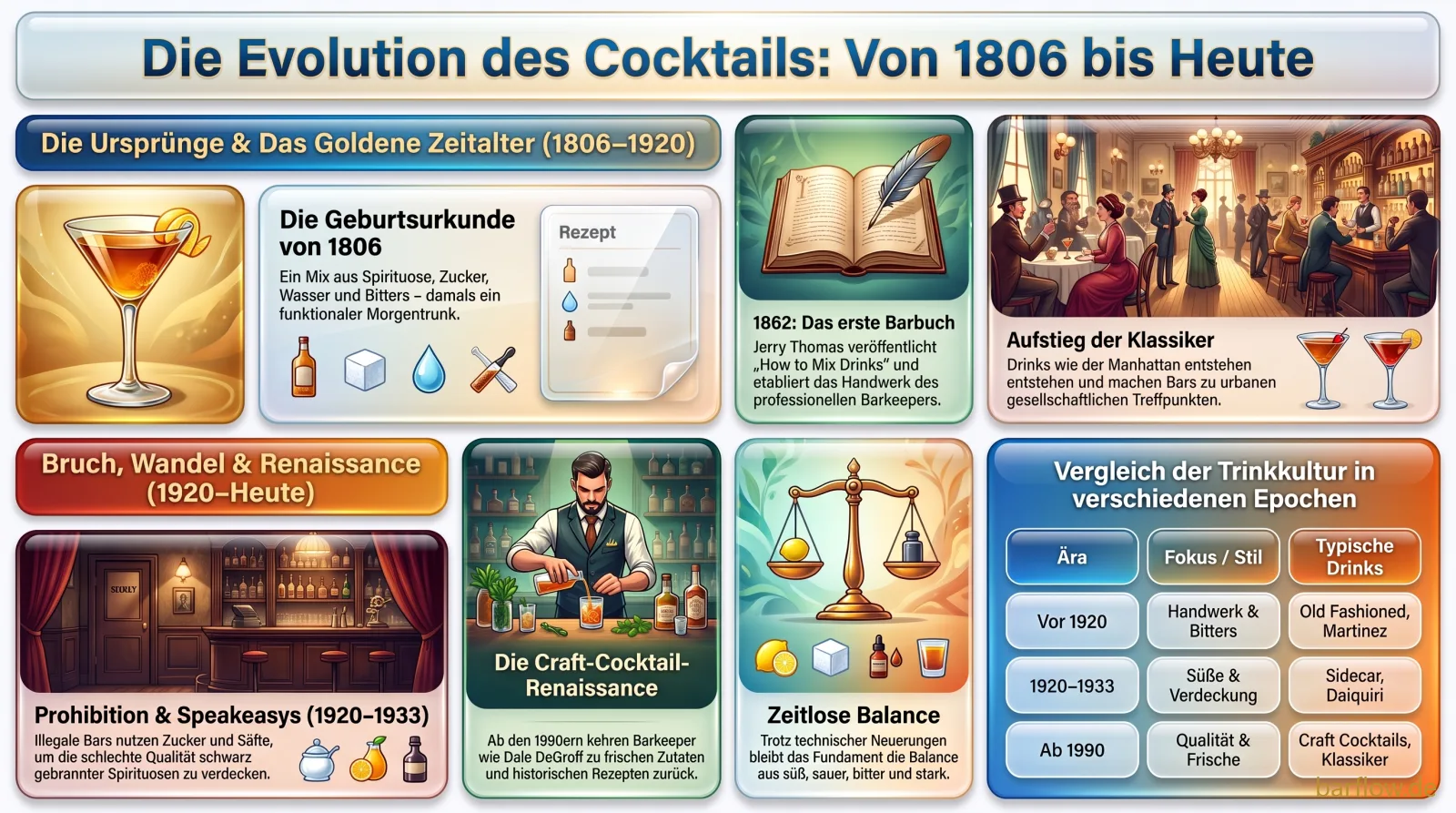
The cocktail is not an invention of the 20th century, but the result of a long evolution that began in the 18th century. From simple mixtures of spirits, sugar, water, and bitters, a distinct culture with rituals, techniques, and icons developed over two centuries. The history of the cocktail is also the history of bars, migration, and social change.
 Enlarge graphic
The Beginnings: Punch, Sling, and the First Mixed Drinks
In the 18th century, Europeans and colonists primarily drank punch—a mixture of arrack or rum, sugar, lemon, water, and spices, served in large bowls. At the same time, simpler forms developed in North America: the Sling, a mix of spirit, sugar, and water, and the Toddy, which was drunk hot or cold. These drinks were the precursors of what later became known as the cocktail.
The word cocktail first appeared in 1806 in a New York newspaper. It was defined there as a mixture of spirit, sugar, water, and bitters—a description that exactly matches the Old Fashioned, which later became famous under that name. Why the mixture was called cocktail remains unclear. There are dozens of theories, from rooster tails to French eggcups to Creole apothecaries, but none can be proven.
In the first half of the 19th century, the cocktail established itself as an independent category alongside punch, julep, and sling. It was initially a morning drink consumed before breakfast—as a tonic, not an evening indulgence. The bar culture was not yet professionalized, and most drinks were mixed in taverns, hotels, or at home.
The Golden Age: 1860 to 1920
The second half of the 19th century brought the professionalization of the bar. In the USA, the first major hotel bars emerged, and bartenders like Jerry Thomas became celebrities. In 1862, Thomas published the first comprehensive bar book, in which he not only collected recipes but also described techniques and show elements. The profession of bartender became a recognized art form.
During this period, many classics were born: the Martinez, precursor to the Martini, the Manhattan, the Whiskey Sour, and numerous fizzes and cobblers. Drinks became more complex, and ingredients more diverse. In addition to whiskey and gin, vermouth, Chartreuse, and maraschino entered the bars. Ice became commonplace thanks to industrial refrigeration, and the shaker became the standard tool.
Parallel to this, a distinct bar culture developed in Europe. In London, Paris, and later in the grand hotels of the Alps, bars run by American bartenders emerged. They brought their techniques and recipes but adapted them to European tastes. The Martini, originally sweeter and more aromatic, became drier and clearer in Europe.
The golden age ended abruptly in 1920 with Prohibition in the USA. Bars closed, bartenders emigrated to Europe, Cuba, or South America, and cocktail culture moved underground or abroad. In the speakeasies, low-quality spirits and excessive sugar were used to mask the taste. Quality and craftsmanship suffered.
Tiki, Disco, and the Dark Years
After the end of Prohibition in 1933, the bar culture recovered only slowly. Many bartenders had emigrated or abandoned the profession. In the 1930s, Tiki emerged as a new, escapist trend: Don the Beachcomber and later Trader Vic created exotic drinks with rum, fruit juices, and elaborate decoration. Tiki was fantasy and spectacle, not a return to the classic bar.
The 1950s and 1960s brought Martini mania, but also a simplification of bar culture. Vodka replaced Gin, sweet liqueurs and ready-made mixes became popular. In the 1970s and 1980s, disco aesthetics dominated: colorful, sweet drinks with cream and liqueur, served in large glasses with umbrellas. Classic recipes faded into obscurity, and the profession of bartender lost prestige.
It wasn’t until the 1990s that a counter-movement began. In London, New York, and San Francisco, bars opened that focused once again on classic recipes and techniques. Bartenders like Dale DeGroff and Dick Bradsell became pioneers of a renaissance that rediscovered the craft and history of cocktails.
The Cocktail Renaissance and the Present
Since the 2000s, bar culture has experienced a worldwide renaissance. Classic drinks like the Old Fashioned, the Negroni, and the Daiquiri are back in vogue—not as museum pieces, but as living traditions. Bartenders experiment with new ingredients, techniques, and formats, without forgetting the fundamentals.
The renaissance is also a return to craftsmanship. Syrups, bitters, and liqueurs are made from scratch again, ice is cut into different shapes, and spirits are selected with care. At the same time, bar culture has become more democratic: recipes are available online, bartenders share their knowledge, and the audience is more informed than ever before.
Today, the cocktail is a global phenomenon. In Tokyo, Singapore, Mexico City, and Berlin, bars are emerging that blend local traditions with international techniques. The history of the cocktail is not over—it continues to evolve as craft, culture, and an expression of hospitality.
Related content
Frequently Asked Questions
When was the word “cocktail” first used?
The word “cocktail” first appeared in 1806 in a New York newspaper, where it was defined as a mixture of spirits, sugar, water, and bitters. The origin of the term remains unclear to this day.
Why did the golden age of cocktails end?
The golden age ended in 1920 with the introduction of Prohibition in the USA. Bars closed, many bartenders emigrated, and drink quality declined due to the availability of only low-quality spirits.
What was the Cocktail Renaissance?
The Cocktail Renaissance began in the 1990s and refers to the rediscovery of classic recipes, techniques, and craftsmanship. Bartenders like Dale DeGroff and Dick Bradsell were pioneers of this movement.
What role did Europe play in cocktail history?
Europe adopted many techniques and recipes from the USA but developed its own bar culture. Particularly in London and Paris, bars emerged that adapted American drinks to European tastes. During Prohibition, many American bartenders became active in Europe.
