
The Daiquiri is one of the few classics whose origin can be traced back to a specific place and time. The combination of white Rum, lime juice, and sugar emerged around 1900 in Cuba and became the template for countless variations in the following decades. What began as a simple drink for American engineers developed into a symbol of Cuban drinking culture and craftsmanship behind the bar.
 Enlarge graphic
Daiquiri – the place and the legend
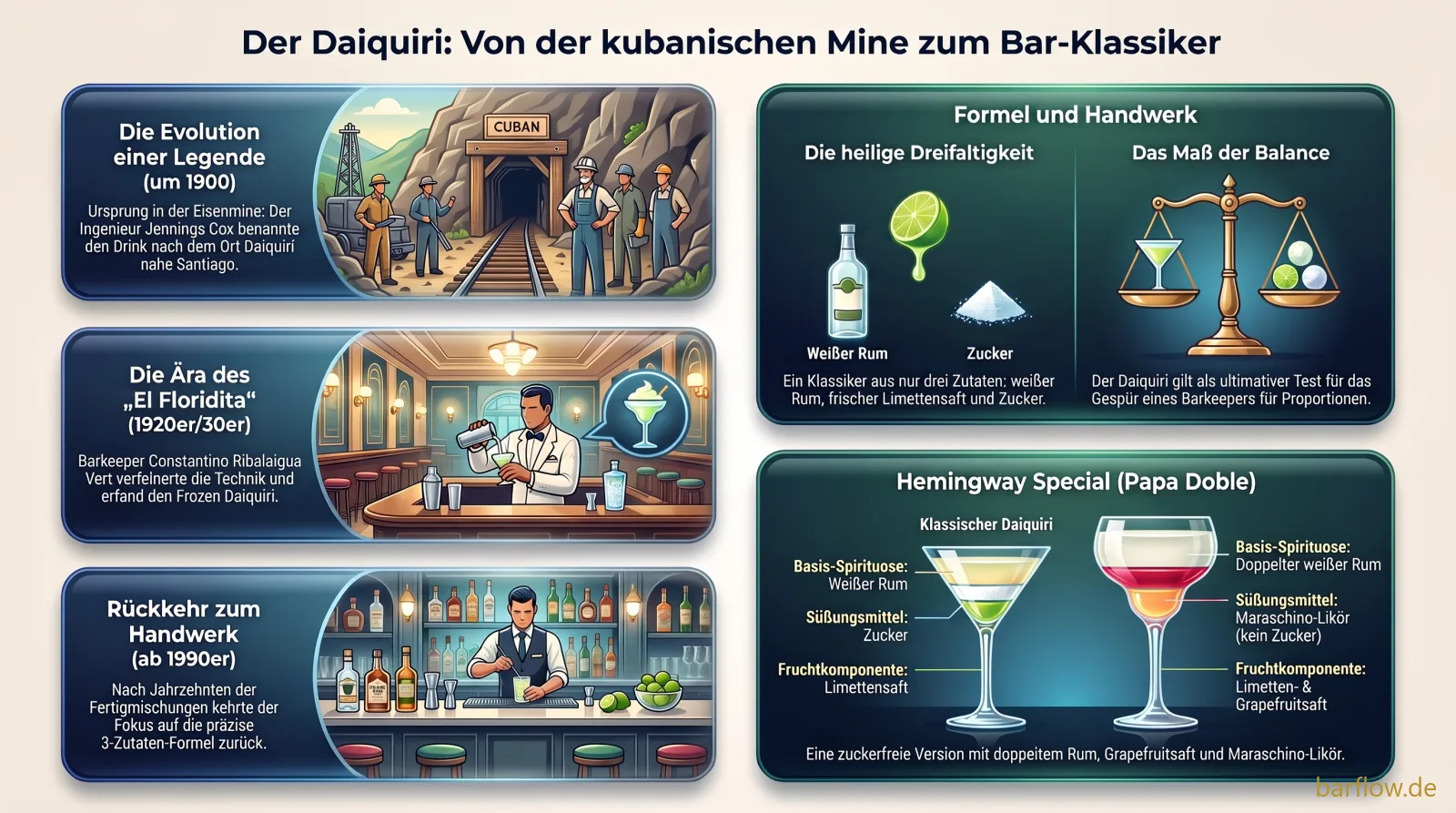
The name Daiquiri comes from a small town on Cuba’s southeastern coast, not far from Santiago. Around the turn of the century, the Spanish American Iron Company operated iron mines there. Jennings Cox, an American mining engineer, is often credited with first mixing the drink around 1898 or 1900. According to the story, he ran out of Gin during an improvised reception and instead used locally available white Rum, which he mixed with lime and sugar to create a refreshing long drink.
Whether the anecdote happened exactly like this can no longer be definitively verified. What is certain is that the combination of Rum, lime, and sugar was already widespread in Cuba long before Cox named it. The Daiquiri was therefore less an invention than a formalisation and naming of an existing drinking habit. Cox and his colleagues brought the drink to the bars of Santiago and later to Havana, where it quickly became popular.
Havana and the bar era
In the 1920s and 1930s, Havana became a hub of international bar culture. During Prohibition in the United States, American guests flocked to the island, and Cuban bartenders developed their own technically demanding style. Constantino Ribalaigua Vert, head bartender at El Floridita, played a key role in shaping the Daiquiri. He refined the proportions, worked with crushed ice, and invented variations such as the Frozen Daiquiri and the Hemingway Daiquiri, also known as Papa Doble.
Ernest Hemingway, who lived in Cuba for years, became the drink’s most prominent advocate. His version omitted sugar, doubled the Rum, and added grapefruit juice and Maraschino. Ribalaigua and El Floridita turned the Daiquiri into a symbol of Cuban elegance and technical skill. The drink became synonymous with shaking, balance, and reduction to the essentials.
From classic to frozen machine
After the Cuban Revolution in 1959 and the end of American tourism on the island, Daiquiri culture shifted to the US and Europe. In the 1960s and 1970s, the Frozen Daiquiri became a mass phenomenon, though often in a heavily simplified form. Electric blenders and pre-mixed solutions replaced craft preparation, and the name Daiquiri became synonymous with sweet, frozen fruit drinks.
It was only with the cocktail renaissance from the 1990s onwards that the classic Daiquiri returned to bars. Bartenders rediscovered the original formula: three ingredients, precisely measured, shaken, and served without ice. The Daiquiri became a benchmark for technical skill and a sense of balance. Today, it is considered one of the essential classics by which every serious bar must be judged.
What remains in the bar
The Daiquiri has left a lasting mark on the bar. It shows that simplicity and quality are not mutually exclusive. The formula of spirit, acidity, and sweetness became the blueprint for countless Sours and continues to shape how bartenders think about balance. The Daiquiri teaches that proportions, ingredient quality, and shaking technique matter above all else.
Meanwhile, the Daiquiri remains a living drink. Variants such as the Hemingway Daiquiri, the Mulata with dark Rum and cocoa liqueur, or fruity versions with strawberry or mango show how versatile the basic idea is. The Daiquiri is no museum relic but a tool that can be worked with. It connects Cuban history with global bar culture and remains a benchmark for craftsmanship.
Related
- Mojito
- Rum Sour
Frequently asked questions
Who invented the Daiquiri?
Jennings Cox, an American engineer, is often cited as the originator. He is said to have mixed the drink around 1900 near the Cuban town of Daiquirí. However, the combination of Rum, lime and sugar was already widespread in Cuba beforehand.
What is the difference between a classic and a Frozen Daiquiri?
The classic Daiquiri is shaken with ice cubes and served without ice. The Frozen Daiquiri is prepared in the blender with crushed ice and has a chilled, slushy consistency. Both variants go back to Cuban bar tradition.
Why is the Daiquiri so important for bar culture?
The Daiquiri stands for the art of balance and reduction. With only three ingredients, it shows how important proportions, technique and quality are. It is a litmus test for any bar and has influenced the development of many other Sours.
What is a Hemingway Daiquiri?
The Hemingway Daiquiri, also known as Papa Doble, was developed at El Floridita for Ernest Hemingway. It contains twice as much Rum as the original, omits sugar and is complemented with grapefruit juice and Maraschino.
