
The Caipirinha is more than just a cocktail – it is a piece of everyday Brazilian culture that has found its way into bars around the world. Originally a simple home remedy for colds, it became a symbol of conviviality and joie de vivre. But how much of its history is truly documented, and what has survived the journey into international bar culture?
 Enlarge graphic
Origin: Between sugar cane and folk medicine
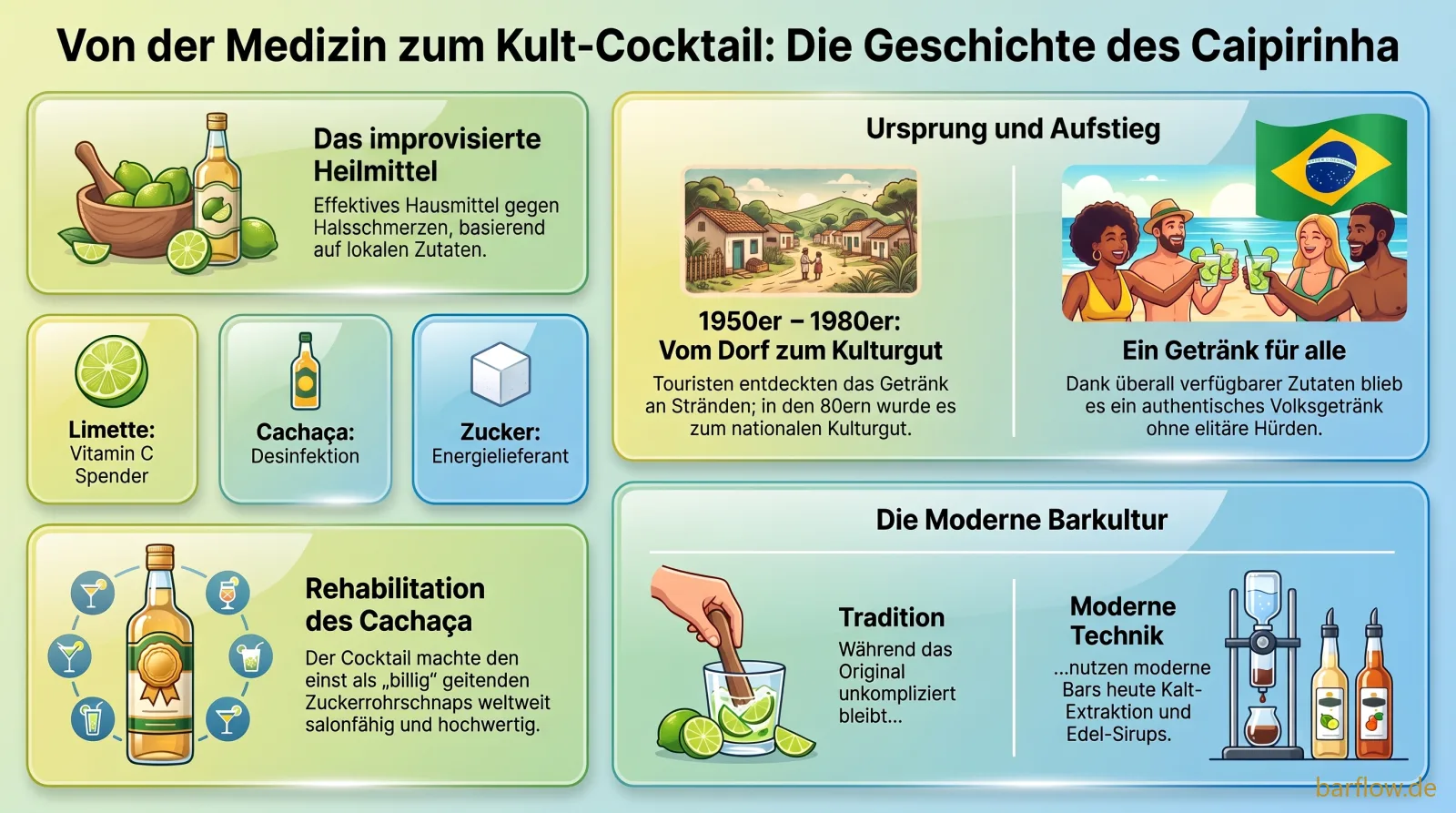
The roots of the Caipirinha lie in rural Brazil, where sugarcane spirit, the Cachaça, had been a staple for centuries. The combination of muddled lime, sugar and spirit likely originated as an improvised remedy to relieve sore throats and fever. The lime provided vitamin C, the sugar energy, and the alcohol acted as a disinfectant. Whether this mixture first appeared on the plantations of the northeast or in the kitchens of the south remains unclear – what is certain is that it existed long before its international career.
It wasn’t until the 20th century that the Caipirinha began to evolve from a home remedy into a drink of the urban middle class. In the cities, it was served in simple bars and at festivals, though it remained a local phenomenon at first. The ingredients were available everywhere, and the preparation required no special skill – a drink for everyone, not just the upper class.
Bar and time: From the backyard to the world
The Caipirinha’s rise to global fame happened gradually and without major marketing efforts. In the 1950s and 1960s, tourists discovered the drink in the beach bars of Rio de Janeiro and Salvador. The balance of sweet, sour and strong suited the tastes of the time, when exotic cocktails like the Daiquiri or the Piña Colada were also popular. Unlike these, however, the Caipirinha was not the product of professional bartenders but a folk drink that preserved its authenticity.
In the 1980s, the Brazilian government began promoting Cachaça as a national cultural asset. The Caipirinha became an ambassador of Brazilian lifestyle, even though at home it was often still served in plastic cups. It wasn’t until the 1990s that it found its way onto the cocktail menus of international bars, where it was initially seen as an exotic curiosity. Today, it is a staple of bar culture, though its original form is often only found in Brazil itself.
What remains in the bar
In modern bar culture, the Caipirinha has undergone a metamorphosis. While the original consisted of little more than lime, sugar and Cachaça, today it is often prepared with high-quality ingredients and elaborate techniques. The lime is no longer just muddled but sometimes even cold-extracted, and the sugar is replaced by raw sugar or special syrups. In Brazil itself, however, it remains a drink of simplicity – made quickly, drunk quickly, with little fuss.
What’s interesting is how the Caipirinha has changed the perception of Cachaça. For a long time, the Brazilian sugarcane spirit was considered cheap hooch, but through the cocktail, it became socially acceptable. Today, there are high-quality aged Cachaças that can be compared to rum or even whisky. The Caipirinha has not only rehabilitated itself but also its main ingredient – a rare case where a cocktail has had a lasting impact on spirits culture.
Related
- The history of the Daiquiri
- Cachaça: Brazil’s forgotten spirit
Frequently asked questions
Why is it called Caipirinha?
The name derives from the Portuguese word caipira, which refers to a rural dweller or farmer. The suffix -inha is a diminutive form, here used affectionately rather than pejoratively. The Caipirinha was thus originally the drink of the simple rural folk.
Is the Caipirinha really a cocktail?
Strictly speaking, the Caipirinha is not a cocktail in the classical sense, as it does not mix a spirit with other ingredients but merely combines a spirit with sugar and fruit. In bar culture, however, it is still considered a cocktail because it follows the same principles of balance and flavor as other mixed drinks.
Why is the Caipirinha sometimes served with ice cubes?
In Brazil, the Caipirinha is traditionally prepared without ice cubes, as the crushed ice from the lime and sugar already provides cooling. In international bars, however, it is often served with ice cubes to keep it chilled for longer. This is an adaptation to drinking habits outside Brazil, where cocktails are usually enjoyed more slowly.
Are there regional differences in the preparation?
Yes, even within Brazil there are slight variations depending on the region. In the northeast, the Caipirinha is sometimes made with other fruits such as passion fruit or pineapple, while in the south the classic lime version dominates. Even the type of sugar can vary – in some areas, unrefined cane sugar is used, while in others, plain white sugar is preferred.
